Traversing Technology And Architecture Evolution
When I look back at my career in IT, one theme stands out: reinvention. I’ve lived through multiple waves of technology change (including Y2K), survived natural calamities while keeping systems running, and learned that success often depends less on what you know — and more on what you’re willing to unlearn.
My journey started in the early ’90s with FoxPro. From there, I embraced every new wave:
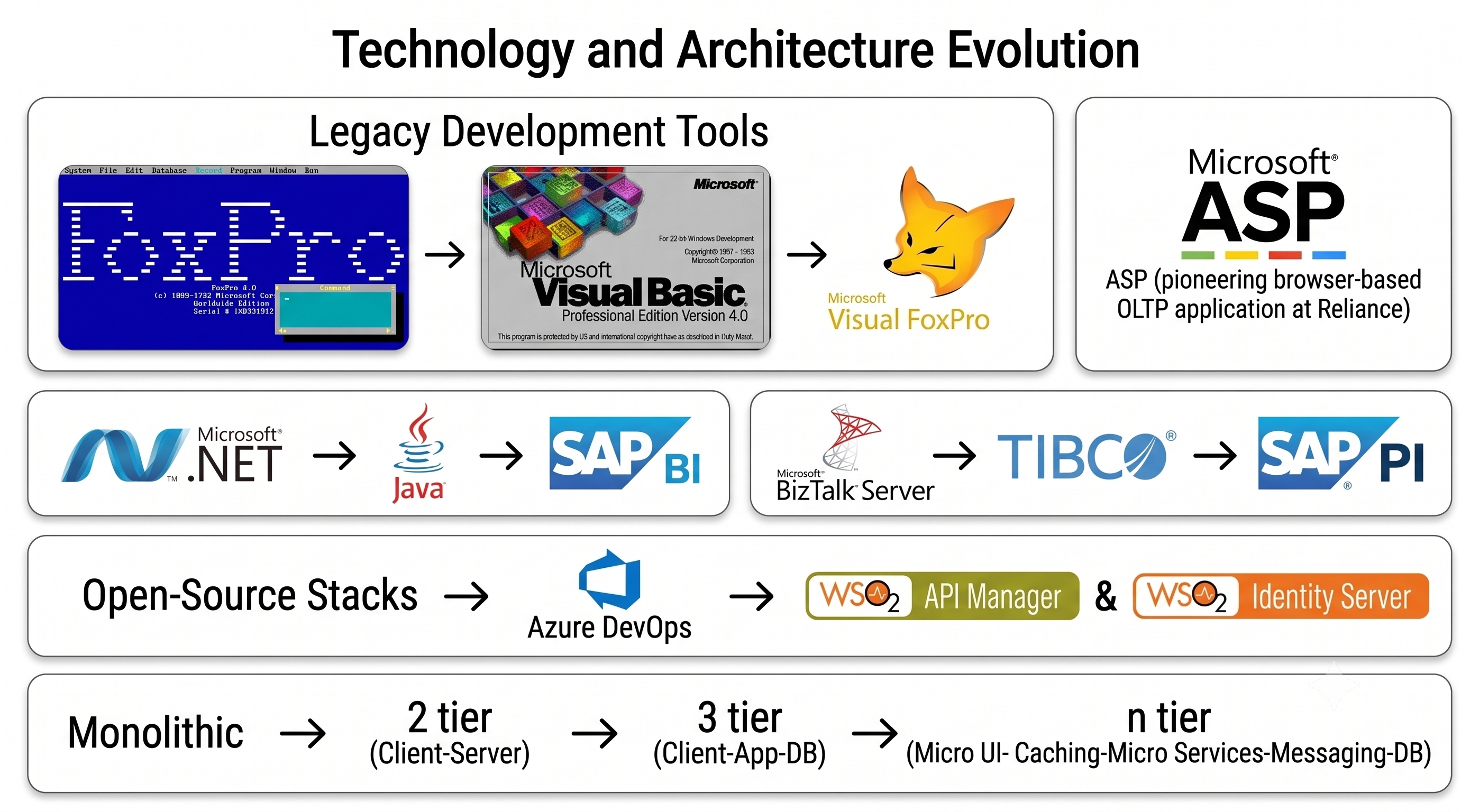 Each shift wasn’t just about learning a new tool — it was about letting go of old mindsets, breaking habits, and relearning how to think differently. I had no mentor, no playbook. Just curiosity, persistence, and the belief that adaptability is the real skill.
Learning Across Domains & People
Technology becomes meaningful only when applied to real problems. I’ve had the privilege to work across multiple domains:
• Employee Life Cycle & Administration – understanding people and organizations
• Finance & Material Management – precision, compliance, and accountability
• Manufacturing & Supply Chain – efficiency at scale
• Healthcare – technology where uptime means saving lives
Every domain came with new challenges and new people to work with. I learned that success comes not just from mastering technology, but from collaborating with diverse teams, mindsets, and cultures.
Resilience in Crisis: The Show Must Go On
My career was shaped as much by disasters as by technologies:
• 1996 Flood at Veraval – First ever experience of natural calamities
• 1998 Cyclone at Jamnagar – systems had to stay alive despite chaos
• 2001 Earthquake in Jamnagar – fear everywhere, but work still needed to continue
• 2005 Flood in Mumbai – wading through submerged roads but ensuring deadlines were met
• 2006 Mumbai Train Bomb Blasts — commuting to work in fear, yet ensuring business continuity.
Those experiences etched one belief deep into me: “The show must go on.”
Technology may fail, nature may test us, but resilience and commitment define who we are.
Principles That Continue To Guide Me
• Continuous learning keeps architecture relevant.
• Unlearning prevents yesterday's success from becoming today's limitation.
• Collaboration turns technology plans into business outcomes.
• Integrity and reliability build long-term trust.
• Resilience sustains transformation during uncertainty.
A Note To Younger Professionals
• Don’t fear change — embrace it. Every new technology is an opportunity to reinvent yourself.
• Don’t cling to the past — unlearn. Make space for new thinking.
• Step outside your comfort zone. Real growth happens when you work across different domains and people.
And when life throws storms your way, remember — the show must go on.
Final Thought
From FoxPro to APIs, Visual Basic to DevSecOps, monoliths to microservices, floods to earthquakes, my journey has been about adaptability, persistence, and learning without a playbook. Don’t wait for perfect conditions. Start where you are. Unlearn, relearn, adapt, and keep moving forward.
Life's Motto: "Don't STRESS, Do your BEST, Forget REST"